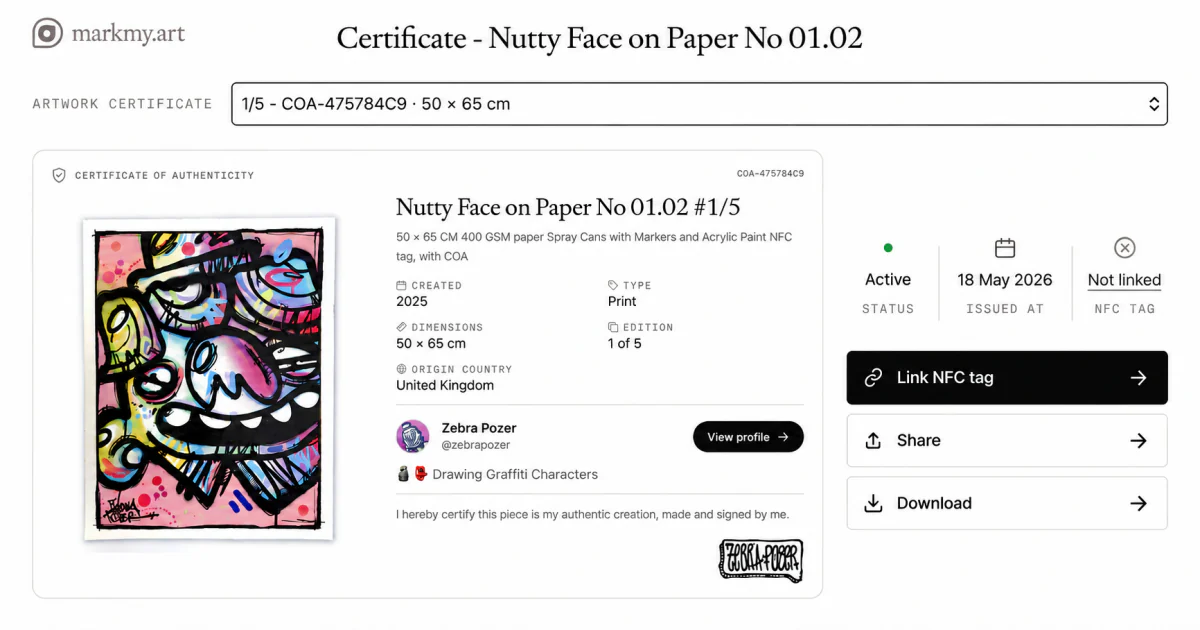
What should a certificate of authenticity for prints include?
A print certificate checklist with edition numbers, open editions, paper, process, dimensions, dates, signatures, and a worked example with sample wording.
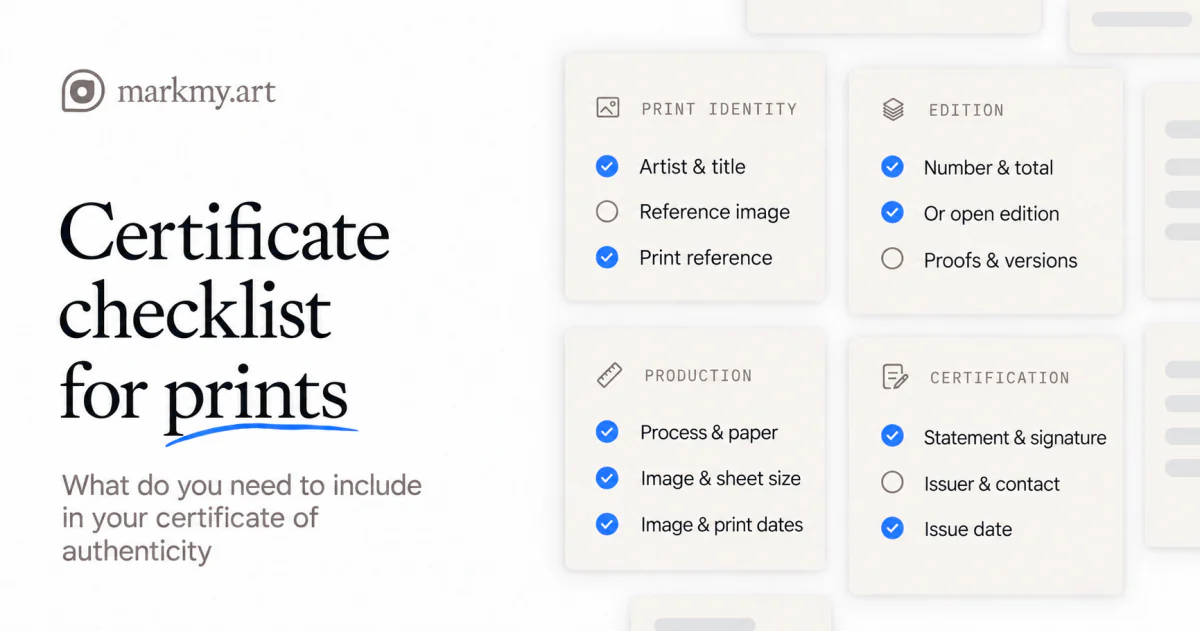
What belongs on a print certificate?
A certificate of authenticity for a print should identify the image and the physical copy. Record the artist, title, how it was made, its edition, and who confirms that it is authorised.
Requirements vary; check what your gallery or marketplace asks for.
- Artist, title, and reference image.
- A unique reference for this print.
- Edition number and total, or a clear open-edition label.
- Printing process, paper or other material, and relevant finishing.
- Image and sheet dimensions, with units.
- Work or image date, print date, and certificate issue date.
- Signature or other markings, authenticity statement, and issuer contact.
State the edition number and what the limit covers
“7/25” means print 7 in a numbered edition of 25. State which image, size, paper, or colour version the limit covers. Describe other versions separately.
State any proofs outside the numbered run. “25 numbered prints plus two artist’s proofs” describes 27 authorised prints in that run. Give each proof its own reference and label it as a proof.
For an open edition, write “open edition” and use an individual print reference. Do not use a fraction or “1/1” that suggests a finite edition.
Describe how this print was made
Name the process and material: for example, linocut on paper or pigment inkjet on cotton rag paper. Give the exact paper stock when known. Credit the printer or lab, and record any hand-finishing or mounting.
Measure the image and sheet separately if there are borders. Give the image’s creation date and the print date separately. If you only know a year, give the year.
Match the certificate to the physical print
Describe where the print is signed and numbered. Say whether the signature is applied by hand, printed as part of the image, or absent. These are different facts.
Use the same print reference in your certificate and studio register. Hahnemühle’s certificate system uses matching numbered holograms on the print and certificate. A matching identifier helps someone connect the document to the object.
Example: a certificate for a limited-edition print
This fictional print shows how to fill in the fields.
| Field | Example |
|---|---|
| Artist and issuer | Alex Rowan, artist |
| Title and print reference | Harbour · HAR-3040-007 |
| Reference image | A photograph of the finished print |
| Process and paper | Pigment inkjet print on 308 gsm cotton rag paper |
| Dimensions | Image: 24 × 36 cm. Sheet: 30 × 40 cm. Unmounted. |
| Edition | 7/25 at this size on this paper, plus two artist’s proofs |
| Dates | Image created in 2024; printed in September 2026 |
| Markings | Hand-signed and numbered in the lower margin |
| Certificate issued | 27 September 2026 |
| Signature and contact | Artist’s signature; current studio website or email |
Sample wording, to adapt to your own edition:
I, Alex Rowan, confirm that Harbour, reference HAR-3040-007, is an authorised print of my work. This is print 7 of 25 numbered prints at the size and on the paper described above. There are two additional artist’s proofs in this edition.
For an open edition, replace the edition sentence with: “This is an authorised open-edition print, reference HAR-0042. No fixed edition total is declared.” Sign and date the statement.
Check each print before handover
Compare the certificate with the actual print: number, size, paper, markings, and photograph. Keep a separate register of prints made, allocated, sold, spoiled, or replaced. Use it across your studio, galleries, and print lab.
In Markmy, use the certificate’s public Details field for paper, process, print date, proof notes, or other facts without a dedicated field. Keep private buyer details out of it.
Follow the Markmy print certificate walkthrough to create and review the certificate for each print.